
Fashion T-Shirt
How T-Shirts Are Made – The Journey from Cotton to Your Closet 2026
Apr
How T-Shirts Are Made – The Journey from Cotton to Your Closet 2026
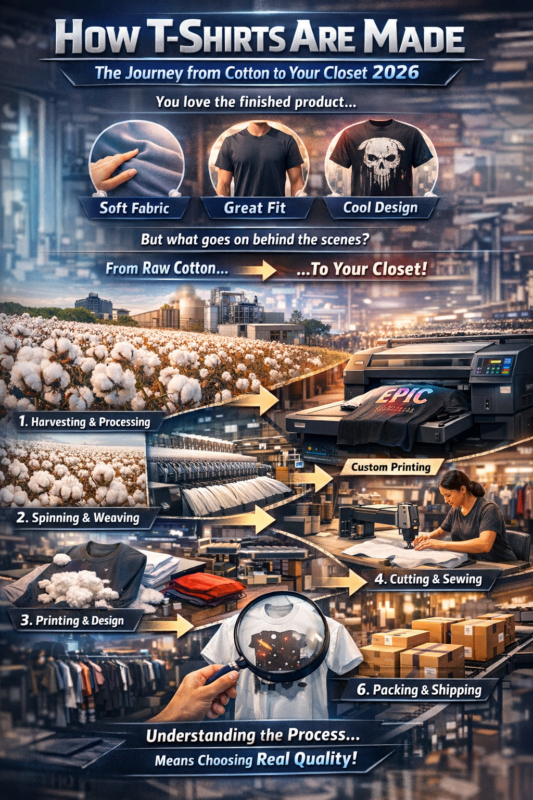
You probably wear T-shirts all the time—but have you ever wondered how T-shirts are made?
Most people only notice the final result:
👉 Soft fabric
👉 Great fit
👉 Cool graphic design
But every high-quality T-shirt goes through multiple stages before it reaches your wardrobe. From raw fibers to finished apparel, each step affects comfort, durability, fit, and style.
In modern fashion and streetwear style in 2026, understanding how T-shirts are made helps you recognize real quality and choose better clothing.
Why Knowing How T-Shirts Are Made Helps You Buy Better
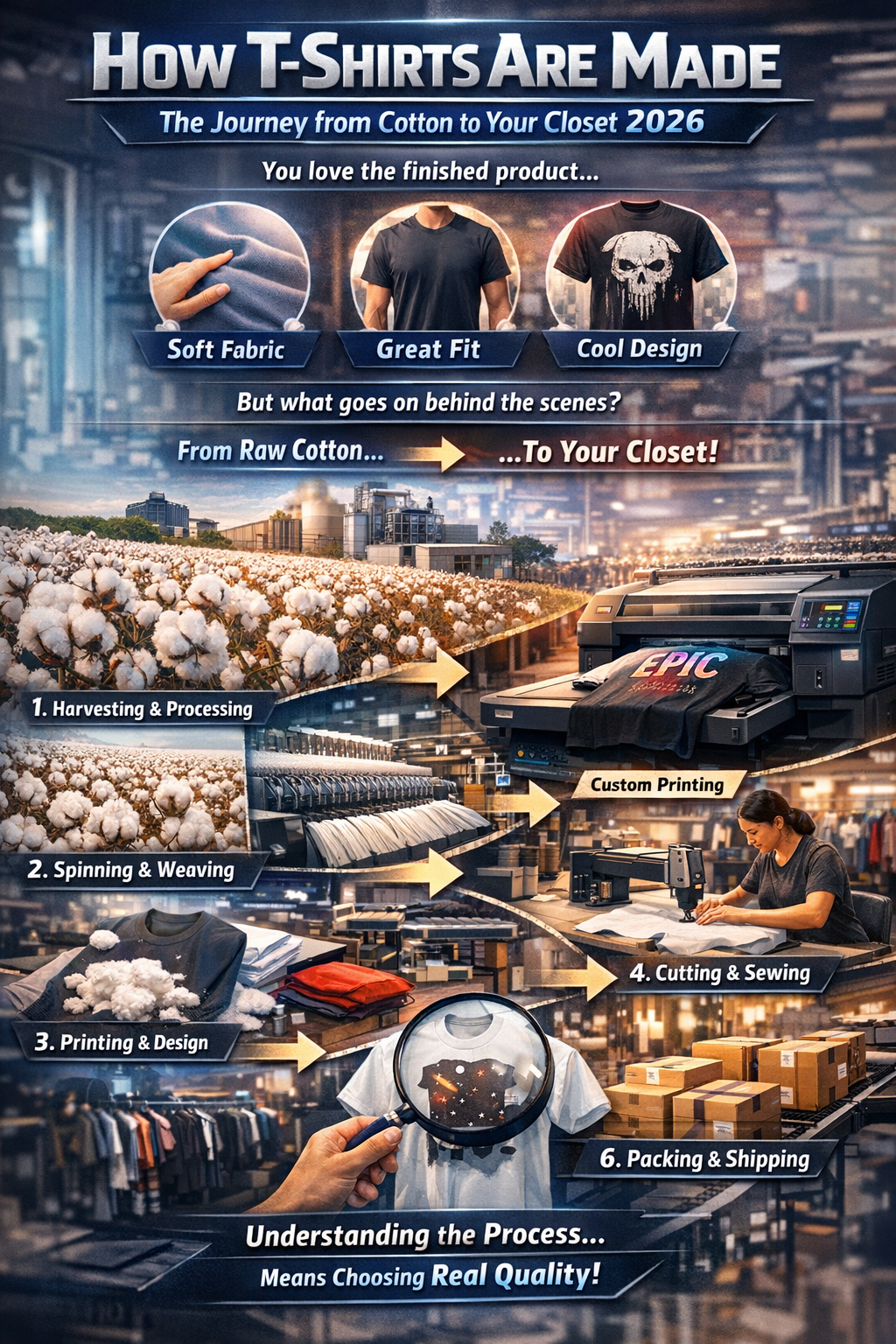
Many buyers focus only on:
- Design
- Price
- Brand name
But the real difference between a cheap shirt and a premium one usually comes from the production process.
Poor manufacturing often leads to:
- Shrinking after washing
- Twisted seams
- Rough texture
- Weak stitching
- Faded prints
That’s why learning how T-shirts are made gives you an advantage when shopping.
👉 Better process = better product
Fashion Graphic T-Shirt – Where Production Quality Becomes Visible
With a Fashion Graphic T-Shirt, quality becomes even easier to notice.
A strong design still needs:
- Smooth fabric for better print results
- Stable fit for a cleaner silhouette
- Durable stitching for repeated wear
- Reliable print methods that don’t crack fast
That’s why premium graphic tees focus on manufacturing—not just artwork.
It Starts with the Fiber
Every T-shirt begins with raw material.
Common sources include:
- Cotton – soft, breathable, natural
- Combed cotton – smoother and cleaner fibers
- Ring-spun cotton – softer and stronger yarn
- Polyester – lightweight and moisture-wicking
- Cotton blends – balance of comfort and durability
The better the fiber quality, the better the final shirt usually feels.
Turning Fiber into Fabric
After fibers are processed into yarn, machines knit the yarn into fabric.
This stage influences:
- Stretch
- Breathability
- Surface smoothness
- Weight of the shirt
A premium T-shirt often feels better because the fabric structure is tighter and more consistent.
Dyeing and Color Treatment
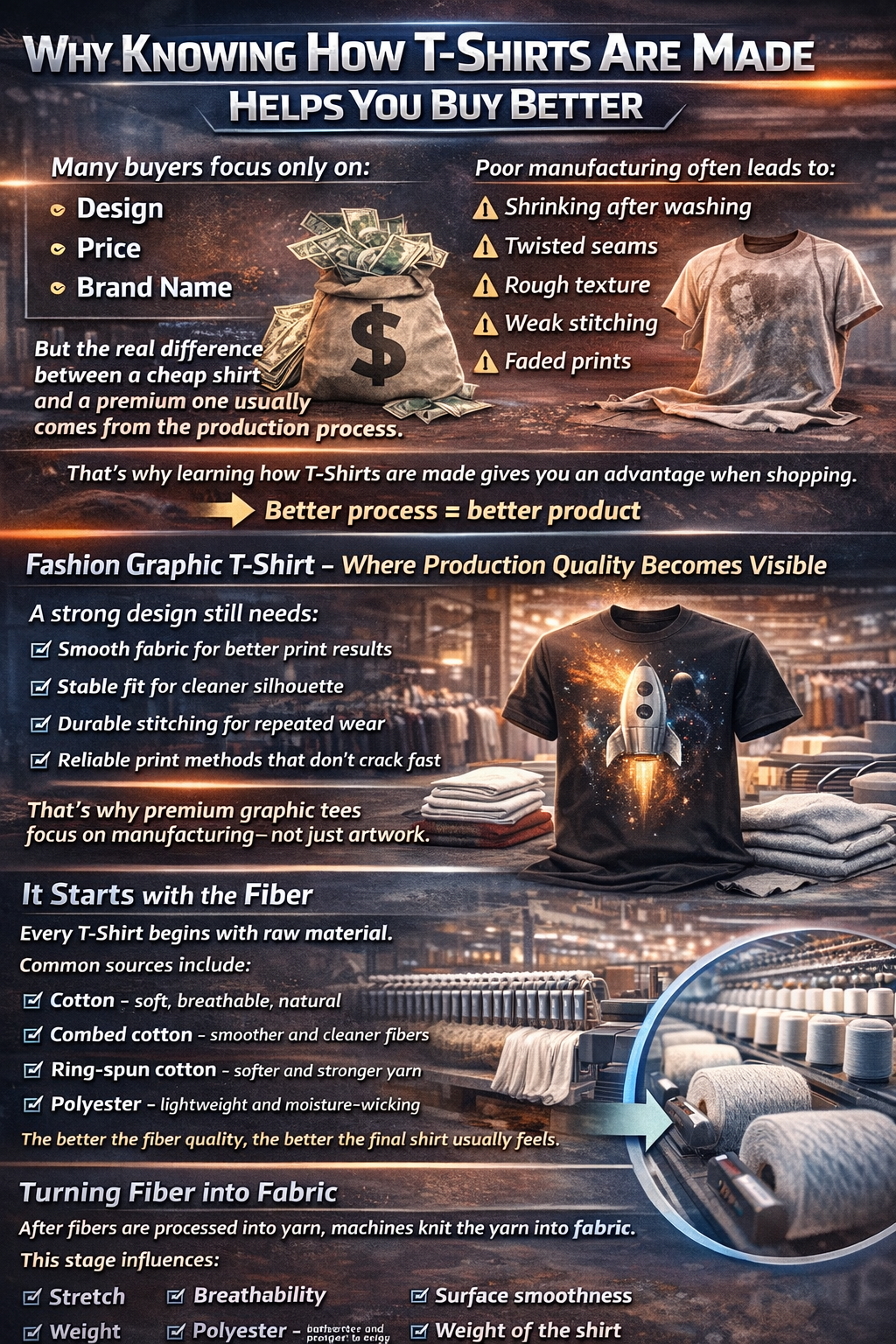
Before cutting, fabric is often dyed.
High-quality dyeing creates:
- Richer colors
- More even tone
- Better fade resistance
Cheap dyeing can lead to:
- Uneven color
- Fast fading
- Color bleeding during washing
This is one reason some shirts look old after only a few wears.
Cutting the Shape
Large fabric sheets are layered and cut into parts:
- Front body
- Back body
- Sleeves
- Neck ribbing
Precision matters here.
Good cutting creates:
- Balanced fit
- Straight side seams
- Consistent sizing
Bad cutting can cause twisting and awkward fit after washing.
Sewing Everything Together
Once cut, the panels are sewn into a finished T-shirt.
Quality sewing includes:
- Straight seams
- Reinforced shoulders
- Strong collar attachment
- Clean finishing
This determines how well the shirt survives repeated use.
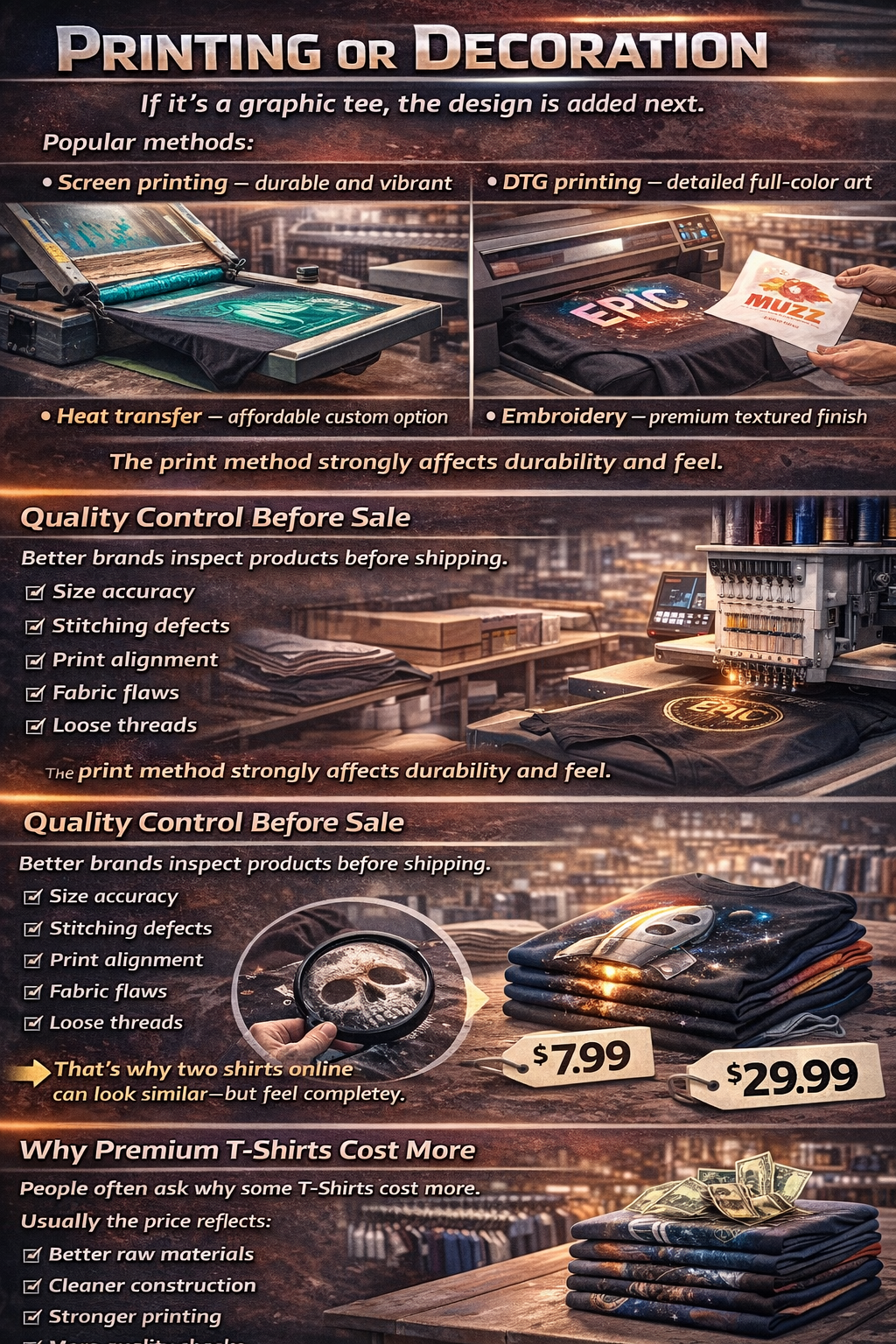
Printing or Decoration
If it’s a graphic tee, the design is added next.
Popular methods:
- Screen printing – durable and vibrant
- DTG printing – detailed full-color art
- Heat transfer – affordable custom option
- Embroidery – premium textured finish
The print method strongly affects durability and feel.
Quality Control Before Sale
Better brands inspect products before shipping.
They check:
- Size accuracy
- Stitching defects
- Print alignment
- Fabric flaws
- Loose threads
Low-end sellers often skip strict quality control.
👉 That’s why two shirts online can look similar—but feel completely different in person.
Why Premium T-Shirts Cost More
People often ask why some T-shirts cost more.
Usually the price reflects:
- Better raw materials
- Cleaner construction
- Stronger printing
- More quality checks
- Better long-term wear
Cheap shirts may cost less today—but often need replacing sooner.
How to Buy Better T-Shirts in 2026
Now that you know how T-shirts are made, shop smarter.
Look for:
- Combed or ring-spun cotton
- Medium to heavyweight fabric
- Strong seams
- Clear material descriptions
- Trusted online stores with reviews
Good brands explain what they use. Cheap sellers often stay vague.
FAQ – How T-Shirts Are Made
How T-shirts are made?
They are made through fiber selection, knitting fabric, dyeing, cutting, sewing, printing, and quality checks.
What material is best for T-shirts?
Cotton, combed cotton, and ring-spun cotton are popular quality options.
Why do some T-shirts shrink?
Low-quality fabric or poor finishing can cause shrinkage.
How are graphic T-shirts printed?
Usually by screen printing, DTG, heat transfer, or embroidery.
Do premium T-shirts use better production?
Yes, they often use better fabric and stricter quality control.
Why should buyers care in 2026?
Because quality clothing lasts longer and feels better.
Final Thoughts – Every Great Tee Has a Story
Understanding how T-shirts are made changes how you look at clothing.
You stop judging only by logo or price—and start noticing:
👉 Fabric
👉 Fit
👉 Stitching
👉 Print quality
👉 Long-term value
Because the best T-shirt is not just stylish—
👉 It’s well made.
